
Which Would You Rather Give Up: Electric Light or Electric Washing Machines?
Plus, what Donald Trump could learn from Jun’ichirō Tanizaki.

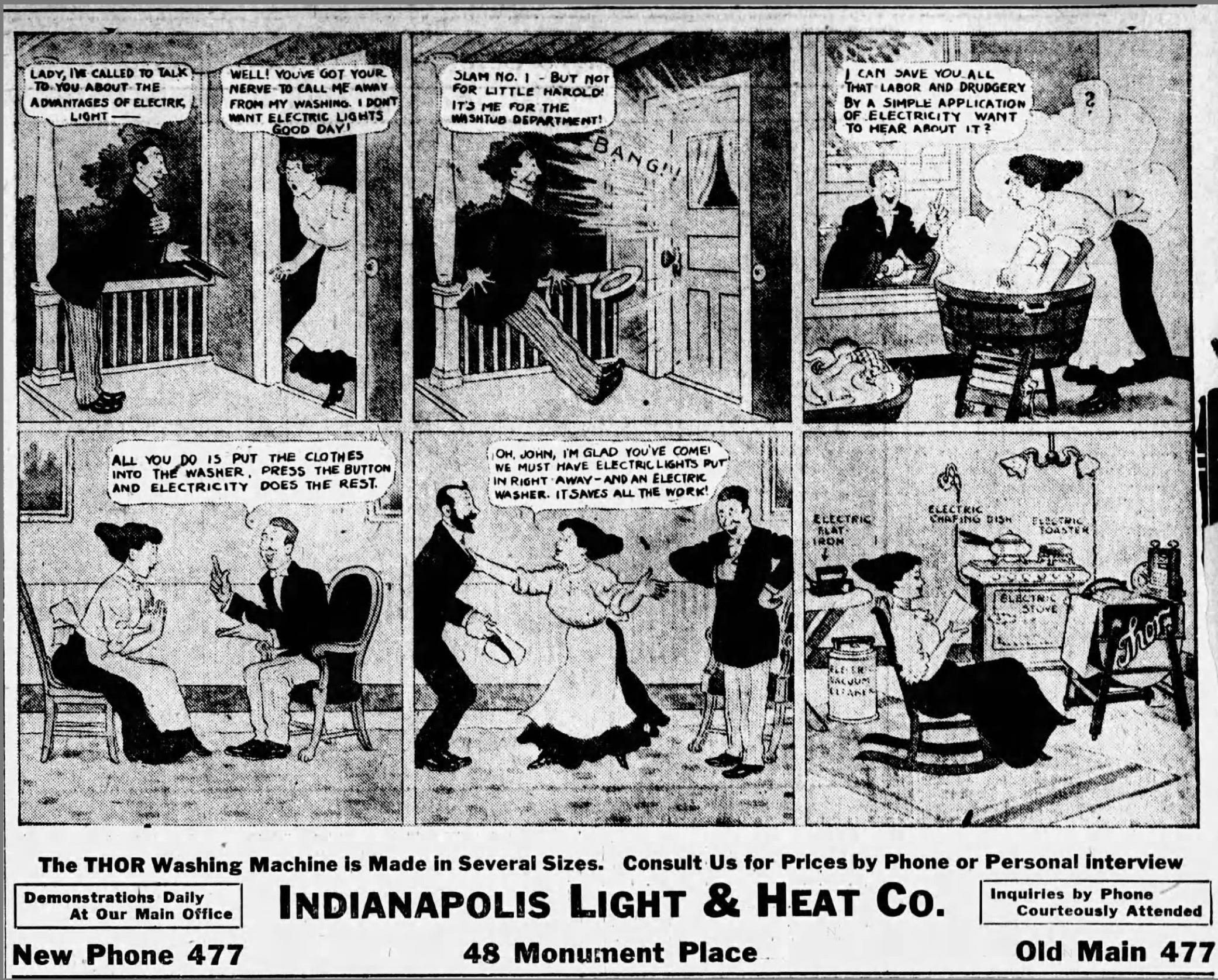
While researching the “Everyday Abundance” episode on doing laundry, I came across the 1910 ad above. The premise of the ad is that lighting alone wasn’t enough to sell electricity, at least to some customers—something I’d never thought of before but that makes perfect sense. Lighting may have been the first domestic application for electricity, but there were reasonable alternatives, and I’m not talking about candles. Wealthy urbanites could use coal gas, which was piped in. For most people, kerosene lamps were the lighting of choice.
And I know from experience that kerosene lamps aren’t bad. Their main disadvantage is the danger of fire if they tip over.
In the late 1940s, when the Rural Electrification Administration was bringing electricity to the hills of north Georgia, my father and grandfather were building an off-grid cabin on some forest land my grandfather’s uncle had given him on the condition that he locate it.1 They furnished the cabin with the wood stoves, kerosene refrigerator, and many kerosene lamps that local people were happy to get rid of. When I was a kid, we occasionally stayed overnight at the cabin, so I’ve been in an environment illuminated only by kerosene lamps. It’s darker than we’re used to—and you’re more likely to go to be early—but once your eyes adjust a kerosene lamp provides enough light to read by.


For people in the 20th century, going electric meant investing in retrofitting kerosene lamps or buying new fixtures. My grandparents had several heirloom lamps—one of porcelain with visible repair marks—in their living room that had originally run on kerosene. If someone was reasonably satisfied with their existing lighting, they might not rush to sign up with the electric company.2
But a washing machine…that was a different story. I love a brightly lit room, more than most people. But given the choice, I would definitely give up the electric lights and keep the washing machine.
Flicker and Flame: The Secret to Gilt with Allure
In his classic work In Praise of Shadows, Jun’ichirō Tanizaki writes of the beauty of works meant to be seen in dim, flickering light.
Sometimes a superb piece of black laquerware, decorated perhaps with flecks of silver and gold—a box or a desk or a set of shelves—will seem to me unsettlingly garish and altogether vulgar. But render pitch black the void in which they stand, and light them not with the rays of the sun or electricity but rather a single lantern or candle: suddenly those garish objects turn somber, refined, dignified. Artisans of old, when they finished their works in lacquer and decorated them in sparkling patterns, must surely have had in mind dark rooms and sought to turn to good effect what feeble light there was. Their extravagant use of gold, too, I should imagine, came of understanding how it gleams forth from out of the darkness and reflects the lamplight.
Lacquerware decorated in gold is not something to be seen in a brilliant light, to be taken in at a single glance; it should be left in the dark, a part here and a part there picked up by a faint light. Its florid patterns recede into the darkness, conjuring in their stead an inexpressible aura of depth and mystery, of overtones but partly suggested. The sheen of the lacquer, set out in the night, reflects the wavering candlelight, announcing the drafts that find their way from time to time into the quiet room, luring one into a state of reverie. If the lacquer is taken away, much of the spell disappears from the dream world built by that strange light of candle and lamp, that wavering light beating the pulse of the night. Indeed the thin, implausible, faltering light, picked up as though little rivers were running through the room, collecting little pools here and there, lacquers a pattern on the surface of the night itself.
Similarly, the gilt-laden decor favored by autocrats and the nouveau riche emulates originals that weren’t intended to be brightly lit. There was no electricity in Versailles or in European cathedrals. Like lacquerware, the gold-laden garments and artifacts of the pre-electric era look more alluring in older forms of lighting.3


Assorted Links:
Friends of Reason senior editor Brian Doherty, who tragically died from an accidental fall in March, are organizing an appropriate memorial for him at Burning Man. Artist Charlie “Blackcat” Smith explains the concept here. Brian’s first book, This Is Burning Man, published in 2004 and reissued with new material a decade later, is the definitive insider’s story of the festival. Contribute to the crowdfunding here.
Speaking of Burning Things: The subject of my most recent WiP column is how artist-inventor-entrepreneur Jan van der Heyden developed the equipment and organization that gave 17th-century Amsterdam a uniquely effective fire department.
Air Conditioning Is Almost as Great as Washing Machines: Gale Pooley explains its origins and spread here. My one quibble would be that he misses the textile angle—because of course there is a textile angle! The term “air conditioning” was coined in 1906 by engineer and textile executive Stuart Cramer, who said he used it “to include humidifying and air cleansing, and heating and ventilation.” In cotton mills, air conditioning put humidity in rather than, as we enjoy it today, taking moisture out. My grandmother, who grew up in Atlanta and moved to Houston in 1927, always counted air conditioning as a great sign of progress in her lifetime. But she would have been too young to have done laundry without a washing machine.
Uncle Henry had been given the land in payment of a bad debt and every time he thought about it, he got mad. It was a large parcel—either 250 or 300 acres, depending on whether you used a flat map or went up and down the hills—but essentially worthless.
The video here shows some converted lamps, as well as a variety of kerosene and whale oil fixtures.
For more on the connection between mystery and glamour, see my book The Power of Glamour.
Owen Young, a farm boy who grew up to be Chairman of General Electric, explained to his biographer what Laundry Day had been like, back on the farm:
"He drew from his memory a vivid picture of its miseries: the milk coming into the house from the barn; the skimming to be done; the pans and buckets to be washed; the churn waiting attention; the wash boiler on the stove while the wash tub and its back-breaking device, the washboard, stood by; the kitchen full of steam; hungry men at the door anxious to get at the day’s work and one pale, tired, and discouraged woman in the midst of this confusion"
See my Retrotech 1925 post: Domestic Technologies
https://chicagoboyz.net/archives/74391.html
Electric washers >>>> than electric light forever. Also, tumble dryers are pretty great.
A couple of years ago, I wrote about my tremendous gratitude for washing machines here:
https://doctrixperiwinkle.substack.com/p/oh-happy-day
There are also textiles, and you’re cited.