


A lovely site called Ordinary Abundance recently went viral with its appreciation of the kinds of everyday wonders whose stories Charles C. Mann and I explore in our podcast “Everyday Abundance.” Using historical quotes and art depicting a midcentury modern home, it captures how amazed people in the past were, or would have been, by things we now take for granted. Imagine, for instance, a world in which few people could have portraits of their loved ones, compared with our photo-saturated lives.
The very shadow of the person lying there fixed for ever! ... I would rather have such a memorial of one I dearly loved, than the noblest artist’s work ever produced.
Elizabeth Barrett Browning, 1843 — On first seeing a daguerreotype, in a letter to Mary Russell Mitford. Preserving a likeness used to require a painted portrait; many families had no accurate image of relatives who died.
I’m pleased to say that the site’s creator credits our “Listening to Music” episode, as well as Charles’s “How the System Works” series, as some of its inspirations.
Reminders of the wonders we take for granted inevitably provoke complaints that people like us are trying to stifle criticisms of present conditions: “Shut up and be grateful.” I can understand why people sometimes get that vibe, especially when they’re being bombarded with statistics.
But this interpretation is completely wrong. Open-ended progress depends on discontent. “Shut up and be grateful” is a prescription for stasis. We don’t live in the best of all possible worlds. We live in a world that can be better if people are free to identify sources of discontent and offer alternatives—and if they believe that improvement is possible.
In a Substack post Laura Mazer recounts her recent experience running a workshop for 30 high school students called Progress in Medicine. “The students were ambitious, intelligent, and high-achieving,” she writes. “And still, in their initial applications, interviews, and surveys, they shared a feeling of pessimism about the future and a lack of confidence in their own ability to influence it.” In response,
I built a curriculum that focused on some of the biggest problems in medicine and health throughout history: from infectious diseases, to obesity, cancer, and longevity. In each topic, we started with stories of the past. How could a physician operating in an era before germ theory even approach the challenge of childbed fever? What was it like for Lady Mary Wortley Montagu, ravaged by smallpox, to consider trying the inoculation procedures she saw in Constantinople on her own child? We met the major innovators and discoverers who moved the world forward, and learned how their discoveries changed everyday life. We interpreted data, but we also focused on the tangible and visceral. Students reviewed their own family trees, and looked at life expectancy across generations. We compared the outcomes of George Washington’s sore throat to their own childhood experiences with taking penicillin. And we ended each case study with a review of the current challenges and cutting-edge work. This included the mantra that progress breeds problems. Antibiotics lead to antibiotic resistance; a world without starvation is a world with an obesity epidemic; a world of increasing lifespans is a world with more cancer. And for each of these problems, the students met directly with some of the people fighting them today.
This is the opposite of “shut up and be grateful.” It’s “be grateful and pay it forward.”
Progress shouldn’t end with the present. And progress itself breeds new problems. As I often say about textiles, it’s better to have the problems of abundance than the problems of scarcity, but they’re still problems. Honoring past innovations—recognizing all the effort and ingenuity embodied in the most ordinary artifacts and activities—is simultaneously humbling and inspiring.
Laura quotes one of her students:
I hadn’t learned much about the history of medicine before this program, but it has not only showed me how far we came, but also how likely it is that there is still so much we don’t know about and need to understand in this day and age. That’s what makes the future so exciting, the fact that any of us could make a new discovery that’s going to be considered ‘simple’ in the future.
Ordinary Abundance concludes:
It is to humanity’s credit that we remain restless in the midst of all of this progress. We continue to look forward, pushing the frontier further with new treatments, new tools, and new institutions that will help future generations in ways we can’t even picture yet.
But our lives today are a gallery of past generations’ heroic efforts to do the same. It serves us, and honors them, to recapture whenever possible the old sense of awe at these wonders that have long since become commonplace.
I know from Substack statistics that readers tend not to click on links, but I strongly recommend visiting Ordinary Abundance, as well as Laura’s post. And here’s an “Everyday Abundance” episode that recognizes that progress—in this case, the industrial revolution—breeds problems.
All eight episodes of Everyday Abundance are now available for free as audio on podcast platforms and video on YouTube. Please listen, watch, subscribe, comment, and share! If you have ideas for topics you’d like us to cover in the future, please leave a comment below. You can also make a second season more likely with a donation here.
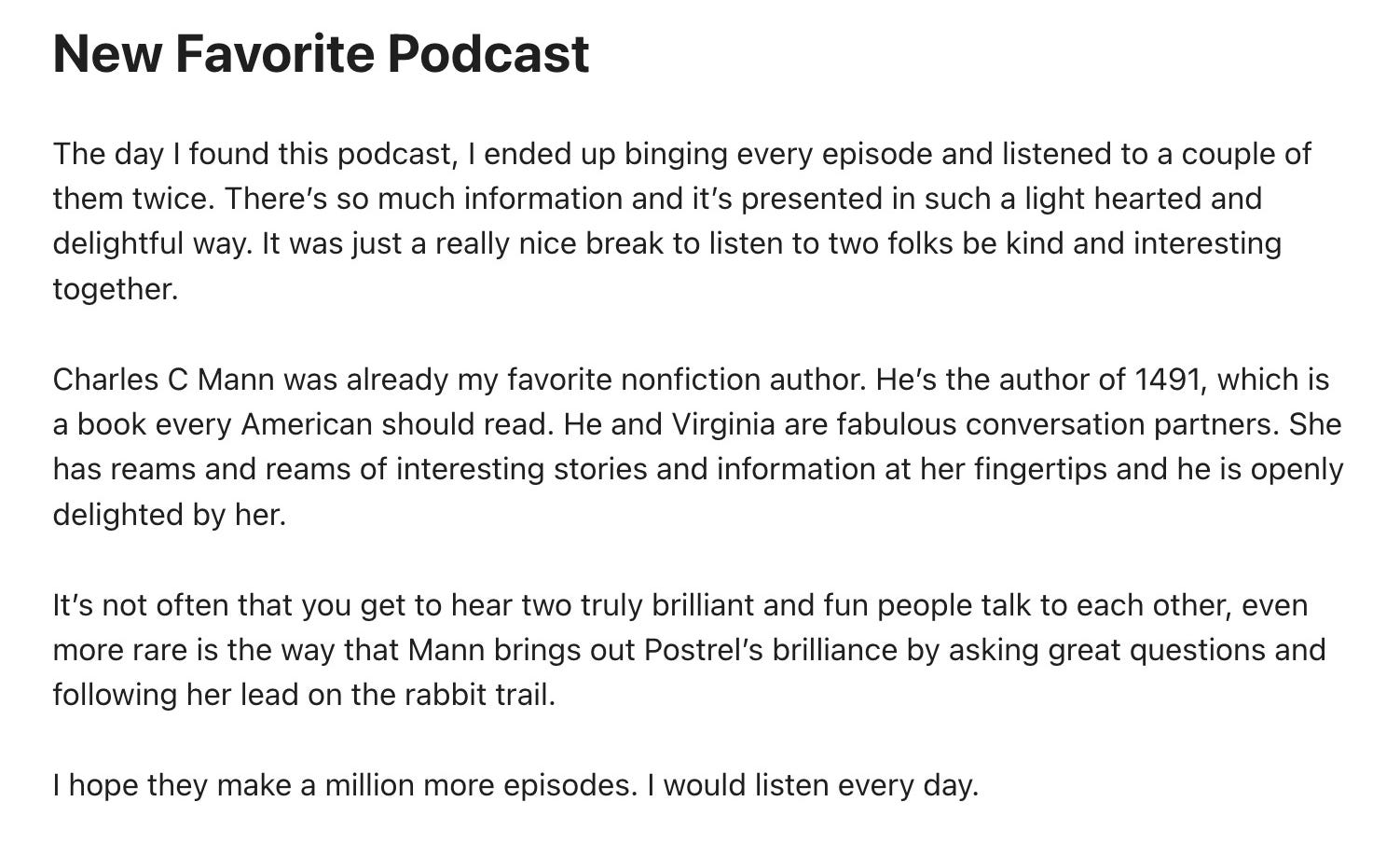
Here’s the latest review on Apple, which I swear is not from someone either of us knows. (I can’t say that of every review.)
And now, in honor of our “Doing Laundry” episode, here’s the full 1920 movie Suds, starring “America’s Sweetheart” and United Artists co-founder Mary Pickford, courtesy of the Internet Archive, which deserves your financial support! Check out the dancing flies at 5:14 and the torrent of collars slightly thereafter.
Like so many good ideas, *gratitude is not complacency* is a type of rigorous truth-telling. Failure to acknowledge achievement is dishonest and misanthropic.
Nice movie, but the quality is abysmal. The resolution is way too low. Worse they "fixed" the speed by injecting blurred composites instead of simply setting the file's FPS to a reasonable number (which 24 is not, for a 1920's movie).
People who don't know how to perform archival film scans should be banned from doing it.
Any idea how to contact these guys?